


There is a moment, somewhere between the second river crossing and the first proper bowl of hủ tiếu, when the Mekong stops feeling like a destination and starts feeling like a living thing. It breathes. It shifts colour with the light. It feeds half of mainland Southeast Asia. And if you slow down enough, it will show you things no road map ever could.
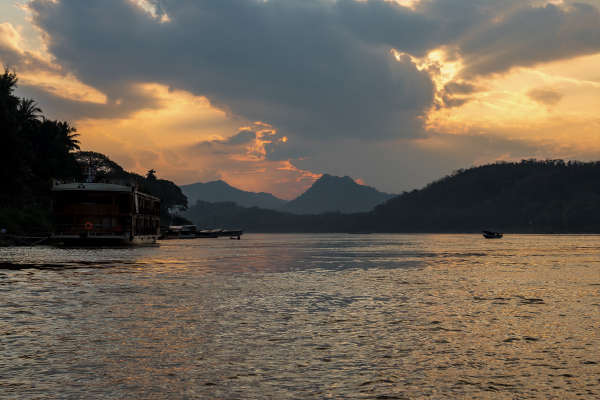
The Mekong River begins in the mountains of the Tibetan Plateau and travels nearly 5,000 kilometres before it gives out entirely, dissolving into the South China Sea through one of the most extraordinary landscapes in Asia. That final act, the delta, is not a gentle fade. It is an explosion. The river fractures into nine great tributaries and an impossible tangle of canals, streams, and waterways that spread across southern Vietnam like the roots of an ancient tree. This is the Mekong Delta: roughly 40,000 square kilometres of flat, astonishingly fertile land where the river's long journey ends, and where daily life is shaped, in every detail, by water.
Vietnam's Rice Bowl
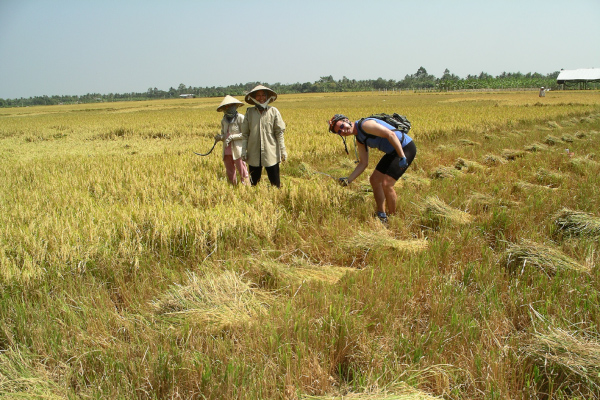
The numbers alone are striking. The Mekong Delta produces more than half of Vietnam's rice and accounts for a substantial share of its fruit, seafood, and agricultural exports. The nutrient-rich silt that the river carries down from the highlands has been building this land for millennia, and the result is some of the most productive farmland in Southeast Asia. On a bicycle, you feel this abundance in every direction.
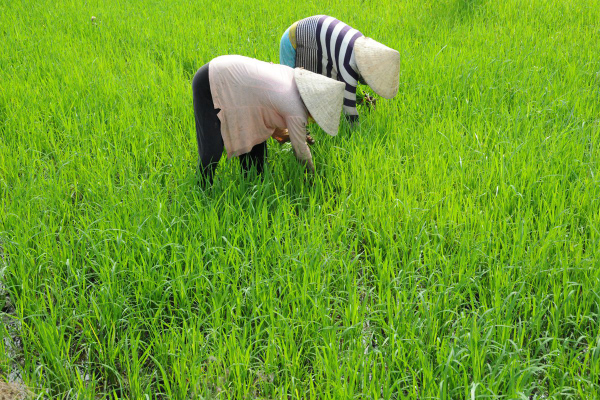
Riding the floodplain between the Co Chien and Hau Rivers, the paddies stretch out in an enormous, vibrant green grid — tidy, deliberate, relentless. Villages exist here on the rhythm of planting and harvesting. Tractors pull along raised bunds. Farmers in conical hats move through the water. There is nothing decorative about any of it. This is working land, and watching it roll past on a bike — quietly, unhurried — gives you a sense of scale that is hard to prepare for.
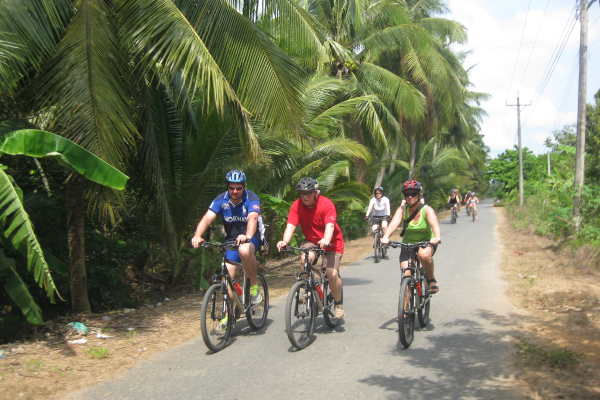
Elsewhere, the landscape shifts. Around Ben Tre, rice gives way to coconut. You weave through dense groves where the palms press in on both sides, past banana plantations and sugarcane fields, crossing the Ham Luong and Co Chien Rivers by ferry. Riverside workshops add sound to the scenery — the hum of timber merchants, the rhythmic scrape of workers shredding coconut flesh for export. These are the delta's cottage industries: small, essential, and easy to miss if you are moving too fast to notice them.
A Borderland Between Two Civilisations
The Mekong Delta is not, historically, Vietnamese territory. For centuries, this was the outermost edge of the Khmer Empire — the civilisation that built Angkor Wat — before Vietnamese settlers gradually moved south and the borders shifted around them. That layered history has not disappeared at all. It is visible in the architecture, the temples, and the faces of the people who live here.
The city of Tra Vinh is the clearest expression of it. Cycling through town, you pass glittering, orange-roofed Khmer Buddhist temples that look nothing like their Vietnamese counterparts — wide, ornate, exuberant. Monks in saffron robes move along the monastery paths. The Khmer-speaking community here is one of the largest in Vietnam, and the culture is fully alive.
Further along, at the edge of a quiet forest, sits Ba Om Pond — a wide, still reservoir said to have been dug by a team of women in a single mythological night. Lotus flowers bloom across the surface. A small temple at the shoreline draws local women who come, quietly and routinely, to have their fortunes told. It is an unhurried scene, easy to underestimate, and genuinely difficult to forget.
Life on the Water
In the Mekong Delta, the river is the main street. Commerce, transportation, social life — all of it flows along the water, and no visit makes sense without getting onto it.
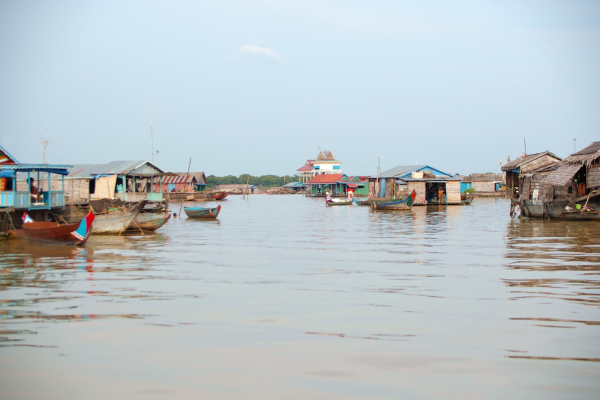
A night at a homestay on An Binh island is one of the better ways to understand this. You reach it by local boat, crossing a wide stretch of river to a small, peninsular village where guesthouses like the Ut Thuy Inn sit close enough to the water that you fall asleep to the sound of it. Dinner is home-cooked by the hosts — fish, vegetables, rice — and the pace of the evening is set by the natural world instead of a schedule.
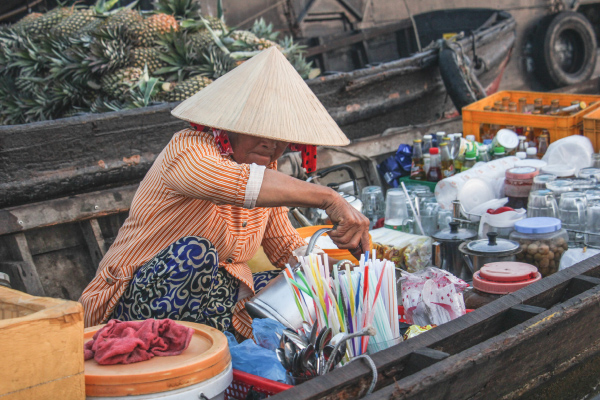
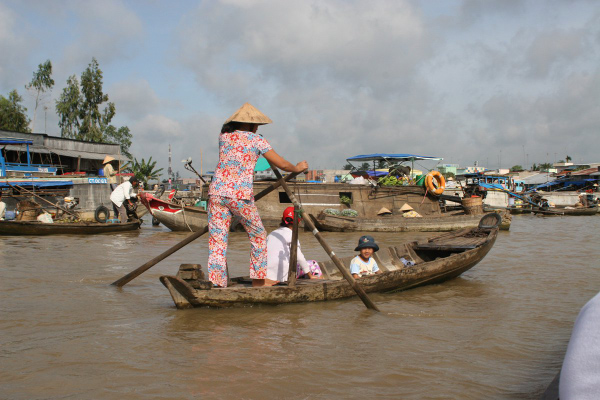
Then there is Cai Rang. Waking before dawn in Can Tho to board a boat while the city is still dark is a commitment. It is absolutely worth it. The Cai Rang floating market is the largest wholesale market in the Mekong Delta, and by the time the light begins to come in over the water, it is already in full, chaotic, magnificent swing. Boats piled high with pineapples, dragon fruit, pomelos, and watermelons jostle for position. Vendors hang samples of their goods from tall wooden poles so buyers can identify them through the morning mist — an ingenious, centuries-old system that has never needed improving. It is loud, purposeful, and entirely indifferent to tourism. Which is exactly what makes it worth seeing.
Where the River Becomes a Border
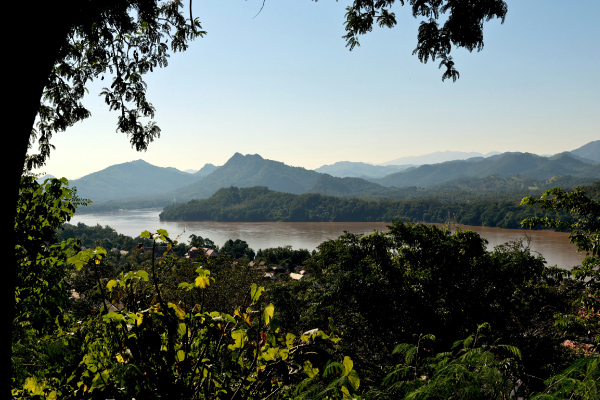
The Mekong does not stop in Vietnam. Follow it north and west and it takes you across one of Southeast Asia's most historically significant border from the delta's dense, green lowlands into the wide floodplains of Cambodia.
The border town of Chau Doc sits right on the river, and the transition here is more than geographic. En route, a stop at the Ba Chuc memorial — a site commemorating one of the Khmer Rouge's most devastating cross-border attacks on Vietnamese civilians in the 1970s — brings the region's modern history into quiet, sobering focus. It is a detour that most itineraries would skip. It is not one you will forget.
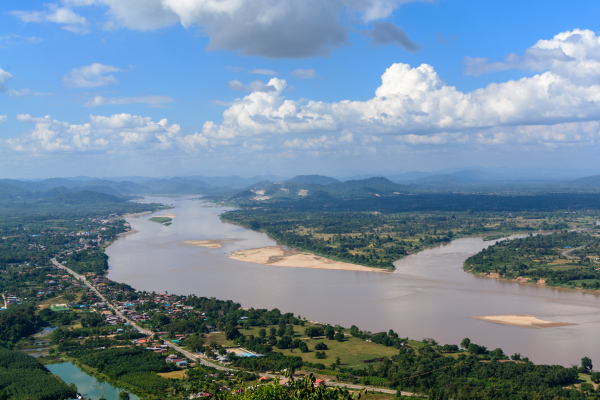
From Chau Doc, the bikes give way to a high-speed boat. The journey upstream to Phnom Penh takes five to six hours, and the landscape changes visibly as you move: Vietnam's tightly cultivated paddies and canal-threaded villages give way to Cambodia's broader, stiller floodplains, where stilted wooden houses stand above the waterline and the scale of everything opens up. The river connects these places, but it also reveals how different they are.
Choose Your Rhythm
The Mekong Delta rewards patience. It is not a place that hands itself over to the hurried. Its best moments — the quiet ferry crossing at dawn, the sound of a village waking up around you, the smell of jasmine and river water and something frying nearby — appear only when you are moving slowly enough to notice them.
Four days is enough to understand what the delta is. The Meandering the Mekong Delta tour covers the essentials with care: the homestay, the floating market, the Khmer temples, the paddies, the river crossings. It is an intimate, grounded introduction to one of Asia's most important and overlooked landscapes.
But the Mekong is also a thread that connects. For those with more time and appetite, the Saigon to Angkor Wat itinerary follows the river north across the border into Cambodia, all the way to the ancient temple complex that the Khmer Empire left behind. Further still, the Saigon to Bangkok route traces a path through Indochina that the river has been drawing for centuries.
However you choose to ride it, the Mekong will change how you see the region — exactly what a good journey is supposed to do.


