


In Thailand, dessert isn't something saved for the end of a meal. It's sold from carts at the school gate, cooked on griddles at the morning market and handed through car windows at roadside stalls, usually for a few coins and almost always in a small bag tied with a rubber band. After a morning on the bike, it's often the best reason to stop.
Most Thai sweets are built from a short list of ingredients: rice, coconut, palm sugar and pandan. What makes them so different from one another is technique, and the stories behind them. Here are five to look out for on your next ride, what they taste like, and where they came from.
1.Mango Sticky Rice (ข้าวเหนียวมะม่วง, Khao Niao Mamuang)
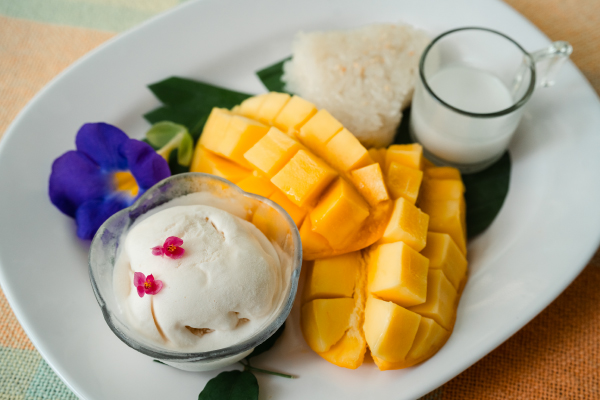
Best known in: Everywhere, but especially in the hot season
If you only try one Thai dessert, make it this one. Warm sticky rice is soaked in coconut cream sweetened with sugar, so every grain turns glossy, rich and faintly savoury. Next to it sits a ripe mango, sliced into thick, fragrant cheeks, cool and almost honey-sweet. A final spoonful of thicker salted coconut cream goes on top, often with a scattering of crisp, toasted mung beans for crunch. The contrast is the whole point: warm and cool, soft and chewy, sweet and just salty enough to keep you coming back.
Sticky rice has been a staple in northern and northeastern Thailand for centuries, and pairing it with fruit and coconut is an old habit across the country. The dessert's season is short and celebrated. From roughly March to May, when Thailand's mangoes are at their best, the vendors selling them seem to be on every corner, and the favourite variety, Nam Dok Mai ("flower nectar"), lives up to its name.
2.Khanom Krok (ขนมครก)
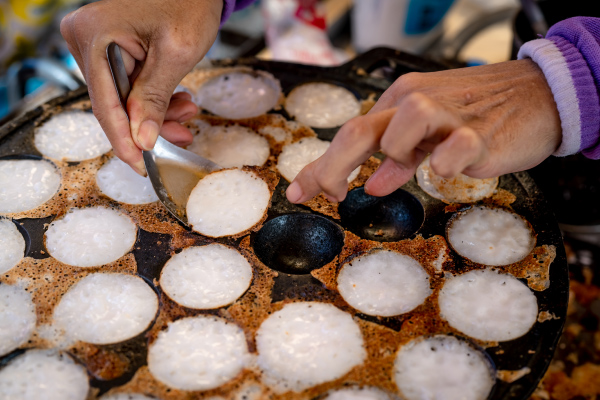
Best known in: Morning markets nationwide
You'll smell Khanom Krok before you see it: toasted coconut and rice drifting from a heavy cast-iron pan dotted with small round hollows. The vendor pours in a lightly salted batter of rice flour and coconut milk, then tops each one with a sweeter, creamier coconut layer and covers the pan until they set. What comes out are little half-moons with crisp, golden edges and a molten, custardy centre that's still hot enough to burn your tongue. Some get a sprinkle of spring onion, sweetcorn or taro on top, and they're usually served pressed together in pairs.
The name comes from that pan. Krok means mortar, and the hollows look like rows of tiny mortars. Khanom Krok has been made in Thailand for generations, and close relatives turn up across Southeast Asia wherever rice and coconut meet a hot pan. It's a breakfast snack more than an after-dinner one, and it tends to sell out early, so it's worth pulling over when you spot a pan on the go.
3.Khanom Buang (ขนมเบื้อง)
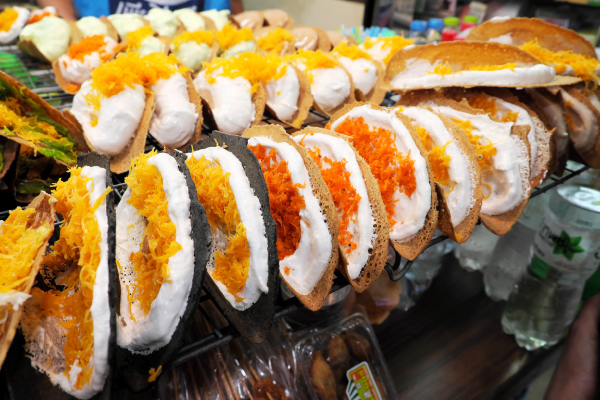
Best known in: Bangkok but can actually be found everywhere
Khanom Buang is part crêpe, part taco, and the sweet version is one of the most satisfying things you can eat standing up. A thin batter of rice flour and mung bean flour is spread across a hot griddle with the back of a spoon until it turns into a paper-thin, crisp shell. On goes a swirl of soft, sweet meringue-like cream, then a topping of either shredded coconut and orange strands of sweet egg yolk, or Foi Thong, the golden egg threads from our last food blog. Each one is folded in half and eaten in a bite or two: a shatter of crunch, then something soft, sweet and buttery.
It's one of Thailand's oldest snacks, often traced back to the Ayutthaya era, and it has long been linked with the royal court and temple fairs. Its sweet toppings tell a later story, though. The egg-yolk sweets used today owe a lot to the Portuguese-influenced kitchens of 17th-century Ayutthaya. There's also a savoury version, filled with coconut, dried shrimp and spring onion, for anyone who'd rather have salty than sweet.
4.Khao Lam (ข้าวหลาม)
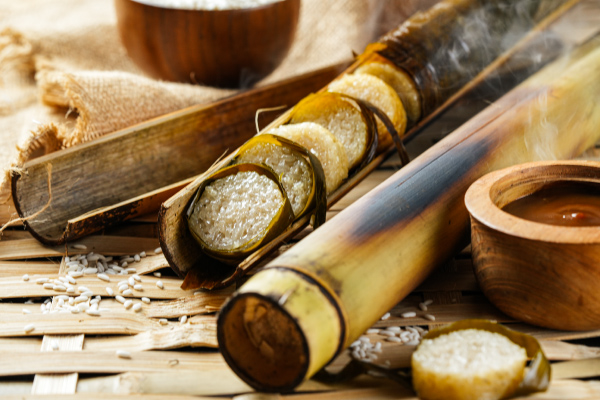
Best known in: Nong Mon Market, Chonburi
Khao Lam comes in its own packaging. Sticky rice is mixed with coconut milk, sugar and a little salt, sometimes with black beans or taro, then packed into lengths of bamboo, sealed and roasted slowly over smouldering coals until the outside is charred black. To eat it, you peel back the bamboo, splitting it into strips, to reveal a cylinder of rice still wrapped in the thin, papery inner skin of the cane. It's dense, chewy and gently sweet, with a smoky edge from the fire and a subtle woody fragrance from the bamboo.
Cooking in bamboo is one of the oldest techniques in the region, a practical way to make rice that keeps and travels well, which was useful long before anyone thought of it as dessert. Today, the town most associated with it is Bang Saen in Chonburi, on the eastern seaboard, where stalls at Nong Mon Market stack the tubes high. It's a classic thing to buy on the way to the coast, and it fits neatly in a jersey pocket.
5.Lod Chong (ลอดช่อง)
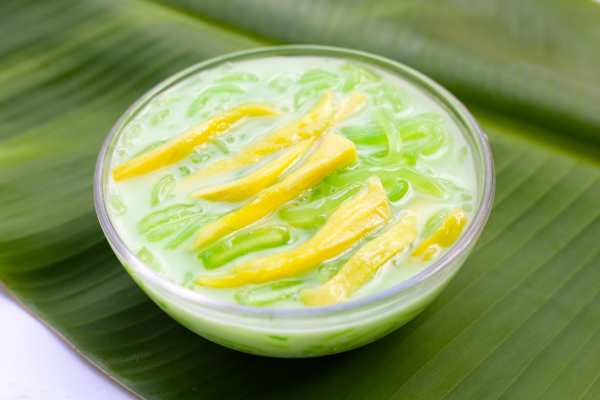
Best known in: Bangkok, especially Chinatown
On a hot afternoon, nothing beats a bowl of Lod Chong. Short, slippery green noodles made from rice flour and pandan float in coconut milk sweetened with palm sugar, piled high with crushed ice. The noodles have almost no flavour of their own beyond a soft, grassy pandan scent. Their job is texture, sliding down cool and smooth while the coconut milk brings richness and the palm sugar adds a deep, caramel sweetness. It's somewhere between a drink and a dessert, and it disappears fast.
The name describes how it's made. Lod means to pass through and chong means a gap, because the soft dough is pressed through a perforated mould into cold water, where it sets into little drops. Similar desserts, such as cendol, are loved in Malaysia, Singapore and Indonesia, and in Bangkok the most famous version is Lod Chong Singapore, named not after the country but after the old Singapore cinema in Chinatown, where filmgoers would grab a bowl before the show. The cinema is long gone, but the shop that made it famous still serves it on Charoen Krung Road.
Thailand's sweets are easy to miss if you only eat in restaurants. The best ones are at markets and roadside stalls, sold by vendors who've often been making the same thing for decades from recipes passed down through generations. On a SpiceRoads tour, our guides know where to find them, and there's no better excuse for a snack stop than a morning in the saddle.
Save Room for Dessert, always!
Ready to explore? Check out our Thailand cycling tours at www.spiceroads.com/destinations/thailand


