


You definitely don't need to be fluent to bike through Thailand, but trust us — knowing a few handy local phrases definitely makes the whole adventure way more fun.
Just a handful of words can change your entire experience. A local vendor who might have pegged you as just another tourist will instead laugh with you about the hill you just climbed. A roadside noodle shop that felt vaguely intimidating suddenly becomes a place where you're welcomed back the following morning. In a country where warmth is a cultural institution, any effort you make with the language is noticed—and usually returned with a friendly smile.
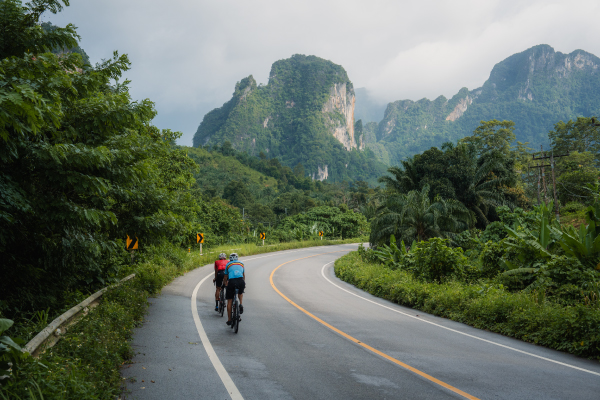
Thai language has a reputation for being a bit difficult, and in some ways it is. It’s a tonal language, which means the same syllable can mean completely different things depending on how you pronounce it. But on a bike tour, perfection is beside the point. Enthusiasm counts for a lot, and our Thai guides are always there to help you communicate.
But for those keen on learning a little “pasa Thai”, here are some phrases we think are well worth knowing before you arrive for your ride.
First, the Golden Rule:Ka and Krap
Before anything else, learn this. In Thai, adding a polite particle to the end of your sentences is the linguistic equivalent of a smile. It signals effort, respect, warmth, and goodwill, and it makes almost everything you say land better.
If you're a woman, that particle is ka (ค่ะ). If you're a man, it's krap (ครับ, sometimes written as krub). You'll hear it constantly attached to greetings, thanks, questions, responses. Think of it less as a word and more as a habit. Once it becomes automatic, everything else gets easier.
The Basics
• Hello / Goodbye = Sawasdee krap / Sawasdee ka — สวัสดีครับ / สวัสดีค่ะ
The same word covers both hello and goodbye. Say it with a slight bow of the head (the wai, with hands pressed together, earns extra points every time!) and you've already made a good impression.
• Thank you = Khob khun krap / Khob khun ka — ขอบคุณครับ / ขอบคุณค่ะ
Use this constantly. Thais appreciate genuine gratitude, and on a bike tour you'll have plenty of reasons to express it — to the locals who give you directions back to the hotel, or the guesthouse owner who offers you a plate of fresh fruits, and the mechanic who patches your tubes with a smile.
• No worries / Never mind = Mai pen rai krap / Mai pen rai ka — ไม่เป็นไรครับ / ไม่เป็นไรค่ะ
Possibly the most Thai phrase you’ll come across. Drop it into conversation when something goes wrong, when someone apologises, when the situation calls for a collective shrug and a smile. It roughly translates as "it doesn't matter" or "no problem," but it carries something harder to translate — a whole cultural philosophy about not sweating the small stuff. You'll hear it everywhere. Use it back, and you'll feel immediately at home.
• Yes / No = Chai (ใช่) / Mai (ไม่)
Simple and essential. Note that mai is also a negation prefix — mai in front of many words flips their meaning, which comes up a lot in the sections below.
On the Bike and the Road
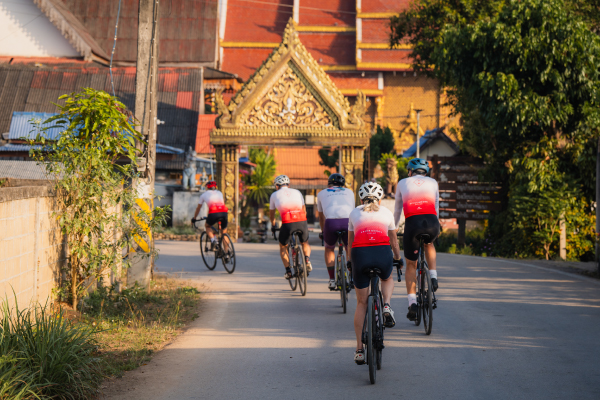
This is where a few words earn their weight in kilometres.
• Turn left / Turn right / Go straight = Liao sai (เลี้ยวซ้าย) / Liao khwa (เลี้ยวขวา) / Trong pai (ตรงไป)
The holy trinity of navigation. When your phone dies, the maps app loses signal, or the hand gestures of a helpful local are enthusiastically pointing in three directions simultaneously, these three phrases cut through everything.
• How far? = Klai mai? — ไกลไหม
Essential for sizing up what's ahead. This word is especially useful when a smiling local tells you the next town is "not far", which in cycling terms could mean anything from 3 kilometres to 30. Follow up with Ki kilomet? (กี่กิโลเมตร) — "How many kilometres?" — for a more useful answer.
• Uphill / Downhill = Khuen (ขึ้น) / Long (ลง)
Thais will often describe a road simply as going khuen or long. Knowing which one is coming changes your approach entirely.
• My bicycle is broken = Jak-kra-yaan sia — จักรยานเสีย
Hopefully unnecessary but good to know and use should you find yourself in a pinch. But rest assured our support vehicle and guides are never far when help is needed.
• Slow down! = Cha cha! — ช้าๆ
Good to know, especially when communicating about our biking pace with others. Also useful: Reo pai! (เร็วไป) which means "Too fast!"
Food and Drink
Cycling in Thailand is, among other things, an extended eating adventure. The roadside kitchens, the night markets, the plastic-stool noodle shops that appear out of nowhere at exactly the right moment. The food deserves at least a little vocabulary.
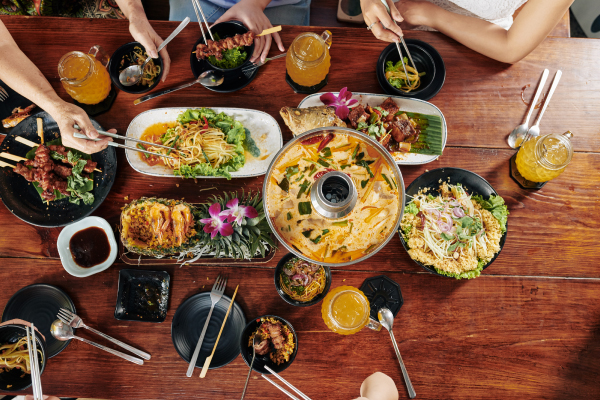
• Delicious = Aroy — อร่อย
• Very delicious = Aroy mak — อร่อยมาก
Say this whenever you mean it, which we are certain will be often. A chef who hears ‘aroy mak’ will most likely give you a larger portion next time.
• Not spicy / Spicy = Mai ped (ไม่เผ็ด) / Ped mak (เผ็ดมาก)
Mai ped will save those who aren’t used to the spiciness of Thai food. Thai "not spicy" and Western "not spicy" don't always align, so consider it a starting point rather than a guarantee.
• Water / Iced water = Nam (น้ำ) / Nam yen (น้ำเย็น)
On a hot day in the saddle, nam yen might be the two most beautiful syllables the entire language.
• Iced coffee = Kafae yen — กาแฟเย็น
Strong, sweet, poured over a bag of ice and served through a straw: a Thai institution. That mid-morning stop for kafae yen at a roadside stall is one of the quiet joys of cycling here.
• I don't eat meat = Mai gin neua — ไม่กินเนื้อ
Handy for vegetarians, though note that Thai interpretations of "no meat" sometimes still include fish sauce or seafood. Gin jay (กินเจ) refers to Buddhist-style vegetarian food — the closest equivalent to a vegan diet, and the better-understood option for stricter requirementsใ
At the Market and Souvenir Stalls
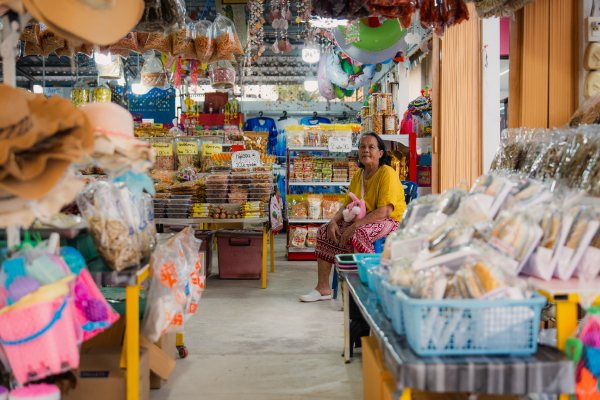
Night markets are part of the experience and a little Thai goes a long way when you're browsing.
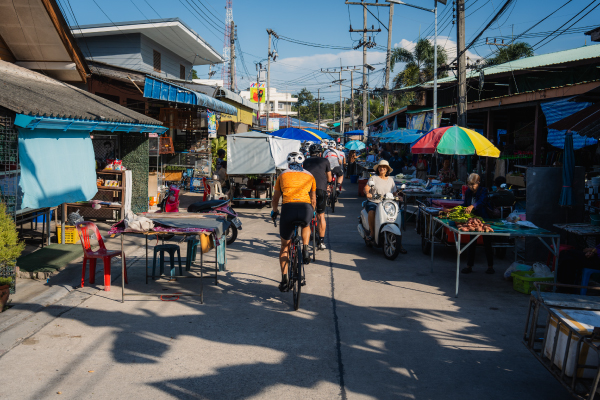
• How much? = Tao rai? — เท่าไหร่
The starting point for every transaction. Ask with a smile :)
• Too expensive = Phaeng pai — แพงไป
Delivered cheerfully, this opens a negotiation. Delivered theatrically gets a laugh.
• Can you reduce the price? = Lot noi dai mai? — ลดหน่อยได้ไหม
The polite version of the above. Dai mai (ได้ไหม) — "Is it possible?" — is one of those phrases that works across dozens of situations and worth tucking away.
• Beautiful = Suay — สวย
For the view you just earned at the top of a climb, the temple at golden hour, the silk at the night market stall. Feel free to use it generously.
You Don't Have to Get It Right
Thai is tonal, which means mispronunciation is almost guaranteed but that's perfectly fine. Most Thais find any effort at speaking their language endearing rather than irritating, and context does get the point across in most situations.
The goal isn't fluency, but rather connection instead. A few words of Thai signals something that translates across any language barrier: that we showed up curious, that we're paying attention, that we're here to experience the culture.
Want to ride through the country you've just been studying? Explore SpiceRoads' Thailand cycling tours at www.spiceroads.com/destinations/thailand.


