


Madagascar doesn't do ordinary. As the fourth-largest island on Earth, sitting alone in the Indian Ocean off Africa's southeast shore, it has spent millions of years evolving in magnificent isolation — and the result is a cast of wildlife so specific that you have to come to Madagascar to see them in the wild. Around 90% of the species here exist nowhere else.
Our Bike and Hike Wild Madagascar tour was built with this in mind. Over 15 days, we ride and hike from the Central Highlands all the way down to the southwest coast, threading together the island's most iconic pockets of wilderness. Here's what you can expect to find along the way.
Golden Bamboo Lemurs
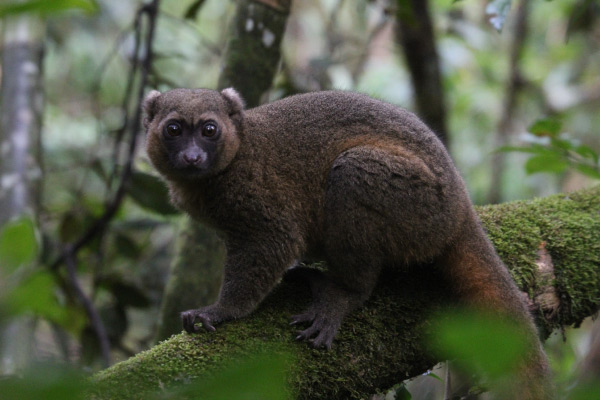
Golden Bamboo Lemurs — Ranomafana National Park
The descent by bicycle into Ranomafana National Park on Day 5 is one of the most dramatic transitions of the entire trip.
Within the space of a few kilometres, the red-earth highlands fall away and the road plunges into a wall of tropical rainforest — dense, mist-shrouded, and loud with life. We base ourselves here for two nights, and it's on Day 6 that the real jungle work begins. Accompanied by a local guide, we set off on foot into the park in search of its most famous residents: the golden bamboo lemur.
These wide-eyed, flame-orange primates were only discovered in 1987, and Ranomafana remains the most reliable place in Madagascar to see them.
They're creatures of habit — small family groups tend to return to the same bamboo groves each day to feed — which means, while sightings can never be guaranteed in the wild, the odds here are usually pretty good.
Expect to spend a few hours navigating root-tangled, muddy trails through a canopy of vines and towering trees, with your guide reading the forest for movement and sound.
Mouse Lemursand Chameleons
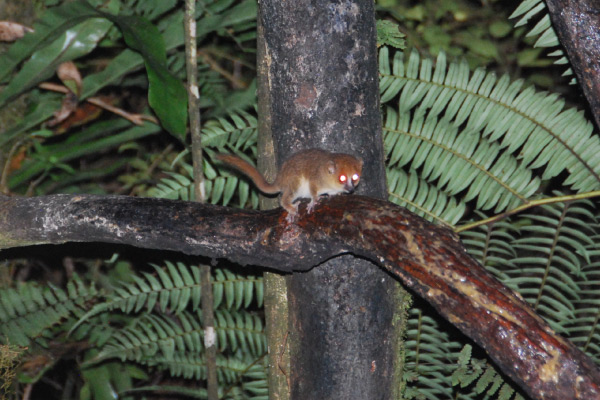
Mouse Lemurs — A Night Walk at Ranomafana
The day doesn't end when the hike does. After the sun goes down, we head out again — this time along the roadside at the park's edge — for a night walk that reveals a completely different set of inhabitants.
With the torchlight of our guide sweeping the branches, we look for mouse lemurs: tiny, enormous-eyed primates no bigger than a fist, darting through the undergrowth.
Spotting one frozen in a beam of light is one of those moments that tends to stay with you.
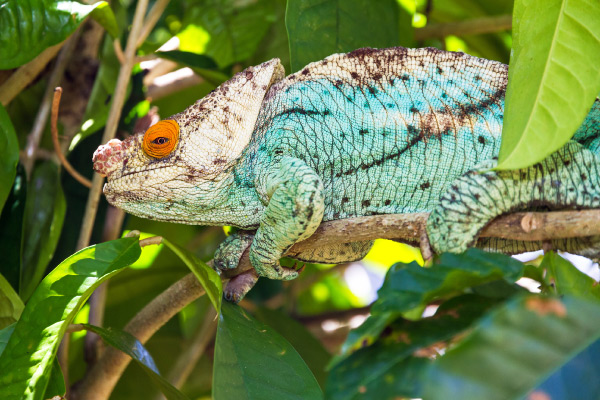
Chameleons — A Night Walk at Ranomafana
Sleeping chameleons are another target — colour-shifted and motionless on their branches, they're oddly easy to spot once you know what you're looking for.
It's a short outing, but the contrast with the daytime jungle is striking enough that most people are glad they didn't turn in early.
Ring-Tailed Lemurs
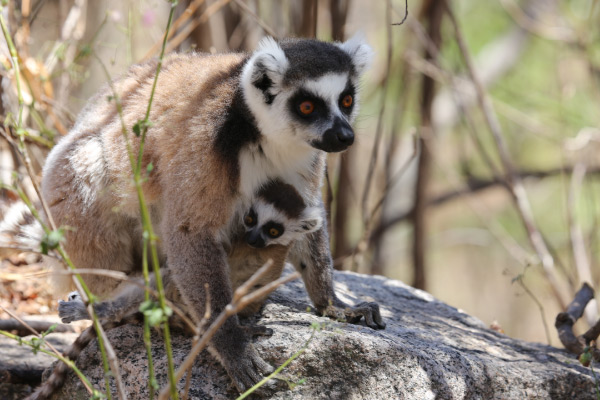
Ring-Tailed Lemurs — The Anja Community Reserve
By Day 9 we've crossed into the savannah of southern Madagascar, the landscape opening up into vast stretches of red earth scattered with enormous granite domes.
One of these bouldered outcrops is home to the Anja Community Reserve — a community-managed sanctuary that protects one of the island's most recognisable animals: the ring-tailed lemur. Unlike the golden bamboo lemur's jungle habitat, ring-tails are creatures of dry forest and open rocky terrain.
At Anja, they've made the boulders their own, lounging in the sun, leaping between rocks, and — if you happen to be eating a snack — eyeing you with the kind of focused attention that makes clear they've done this before. We spend around an hour exploring the reserve on foot before pushing on toward the Andringitra Massif.
It's a brief stop in the context of the day's riding, but the ring-tails have a way of making an impression that lasts considerably longer.
Zebu Cattle
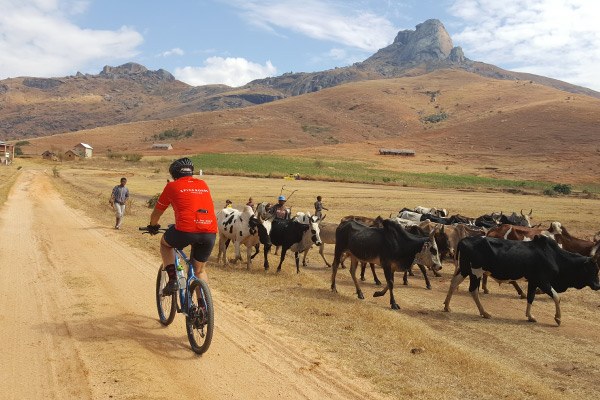
Zebu Cattle — The Horombe Plateau
Not all of Madagascar's wildlife comes in small, wide-eyed packages. On Day 11, after departing the Andringitra on four wheels, we reach the Horombe Plateau — a vast, flat savannah that stretches toward the horizon in every direction.
These are the ancestral lands of the Bara people, Madagascar's most prolific zebu herders, many of whom still maintain a semi-nomadic lifestyle following their animals across the plateau.
When we unload the bikes for the afternoon's riding, the road ahead is quiet and open — but the zebu cattle are never far away.
Dancing Lemurs
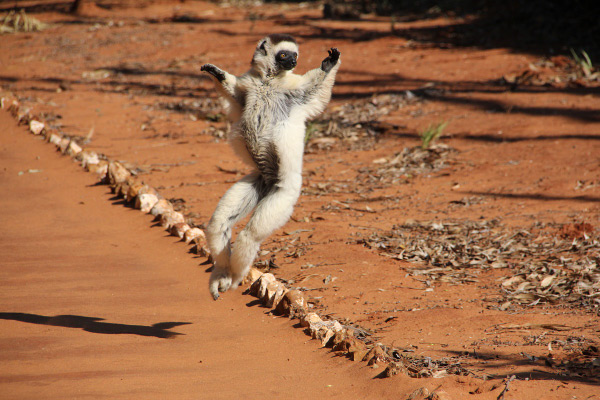
Dancing Lemurs — Isalo National Park
The geological drama of Isalo National Park — Jurassic sandstone towers, deep gorges, and hidden oases carved out over millions of years — makes it one of Madagascar's most striking landscapes.
But Isalo is also home to some of the island's most talked-about wildlife: the Verreaux's sifaka, better known as the dancing lemur.
These long-limbed, black-and-white primates are built for the vertical world of the trees, and when they need to cross open ground, they don't walk — they bound sideways on their hind legs in a motion that looks, unmistakably, like dancing.
We spend Day 12 hiking inside the park at a relaxed pace: through the gorges, past natural swimming pools, and into the lush oases where the sifaka families tend to gather.
Sightings depend on where the animals choose to be, but Isalo is one of the more reliable spots on the island for them, and the setting alone — sandstone walls rising around you, patches of green hidden in the rock — is more than worth the hours on your feet.
A Wildlife Journey That Earns Its Views
The golden bamboo lemurs are found at the end of a jungle trek. The dancing lemurs are waiting inside a labyrinth of stone. And the zebu herds don't part for you — you work your way through them.
This is what 15 days on a bike and on foot through Madagascar actually feels like: not wildlife viewed from a distance, but wildlife encountered as part of a journey through one of the most singular places on Earth.
If that sounds like your kind of adventure, we'd love to have you along. Find full details, departure dates, and booking information for our Bike and Hike Wild Madagascar tour.


