


When most people think of a cycling tour, they picture the riding. The roads, the climbs, the kilometres ridden. And yes — our two Philippines tours deliver all of that across some of the most scenic tropical terrain you'll ever pedal through.
But here's the thing about the Philippines: this country has a habit of stopping you in your tracks when you least expect it. A tiny creature sleeping in the jungle. A landscape tamed by centuries of rice farming. Millions of fish forming swirling shapes just beneath the surface of the sea. Some of the best moments on our Visayas tours happen when the bikes are leaning against a wall.
Here are five off-bike highlights that make cycling the Philippines an experience unlike anywhere else in the world.
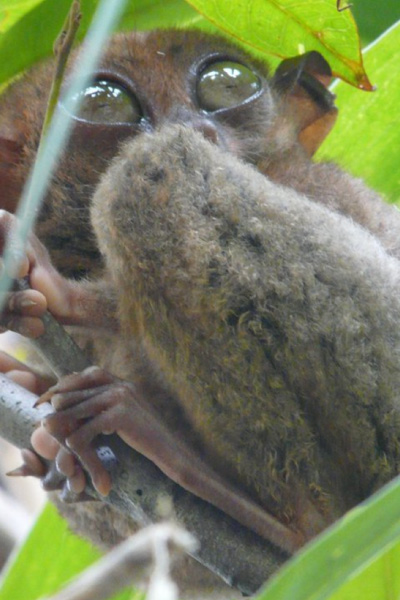
1.Coming Face to Face With the World's Smallest Primate
What is it?
A tarsier is a tiny, wide-eyed primate that fits in the palm of your hand. They're ancient — their ancestors have been around for over 45 million years — and Bohol is one of the few places in the world where you can still find them in the wild.What actually happens?
Early in our Island Hopping the Philippines tour, we make a short detour to a Tarsier Sanctuary just 12 km into the first day's ride. A local guide leads you quietly into the jungle, where the tiny tarsiers sleep upright perched upon thin branches during the day. These creatures literally weigh less than a chocolate bar. Their eyes are bigger than their brains. They can turn their heads almost all the way around.Why it's special:
There's no glass between you and the animals, no performance, no noise. Just a tiny, extraordinary creature going about its day in a tropical forest — and you, standing very quietly, watching. No flash photography, no touching — just respectful wildlife watching the way it should be.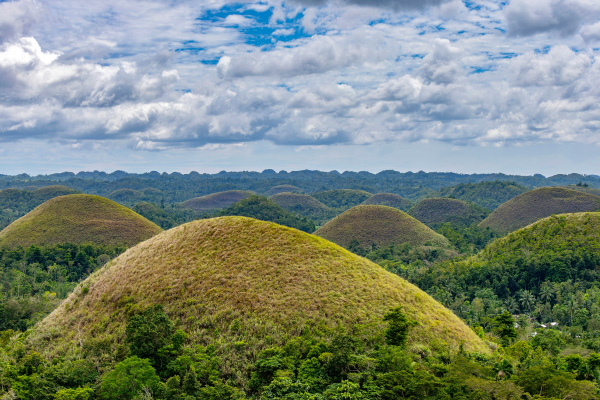 Photo Credit: Maksim Grigorev
2.Standing in Front of the Chocolate Hills
What is it?
Picture over 1,200 perfectly round, dome-shaped hills arranged across a flat plateau as far as you can see. During the dry season, the grass covering them turns brown — hence the name. It's one of the Philippines' most famous natural landmarks, and it's every bit as strange and beautiful in person as it looks in photos.What actually happens?
Both of our Philippines tours pass through the Chocolate Hills, but the approach is different depending on which tour you're on. On Road Cycling the Philippines, we tackle a challenging 18 km climb through the Sierra Bullones highlands before descending to the hills for lunch. On Island Hopping the Philippines, the ride to the hills is more gradual, weaving through rice paddies and coconut groves before taking a vehicle transfer up to an amazing hilltop viewpoint for lunch.Why it's special:
Standing at the top and watching the hills roll toward the horizon in every direction is an incredible sight that is quintessentially Bohol. Locals will tell you the hills were formed by two giants throwing boulders at each other. Geologists have their own explanation. Either way, you'll definitely be taking loads of photos.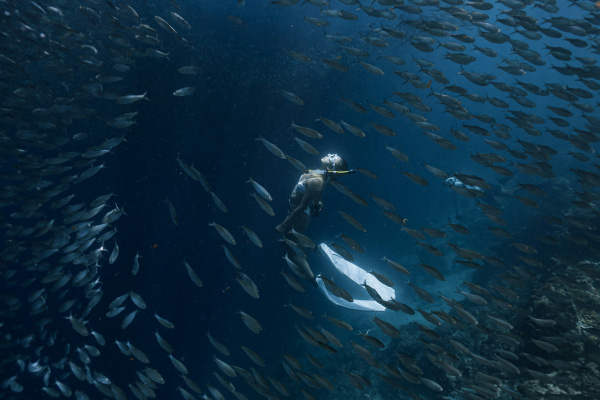 Photo Credit: Chinh Le Duc
3.Swimming With Millions of Sardines
What is it?
Just off the coast of Moalboal on Cebu Island, one of the Philippines' most spectacular natural phenomena happens just a few metres from the shore: massive schools of millions of sardines gather so densely that it sometimes blocks out all light underwater and moves together organically like a single living creature.What actually happens?
On the final morning of Island Hopping the Philippines, before the last day's riding begins, we head to the beach at Moalboal. You can rent a snorkel, wade in, put your face in the water — and there they are. A shimmering, swirling cloud of sardines, shifting shape in response to the currents and to the bigger fish — turtles, trevally — that circle the edges.Why it's special:
You don't need to be an experienced diver to see this amazing sight. The sardines swim so close to shore that anyone comfortable in the water can swim out to them. It sounds almost too simple to believe — but the moment you're floating above that mass of silver sardines moving beneath you, you'll understand why people talk about it for years afterwards.This is an optional activity, but one we strongly recommend.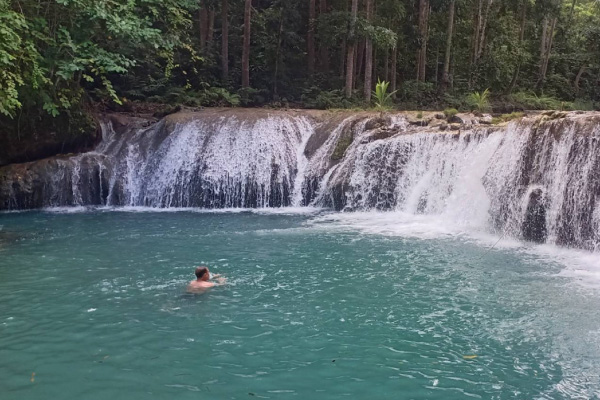
4.A Waterfall Dip and the World's Most Unusual Fish Spa
What is it?
Siquijor is a small, quiet island with a big reputation for mystery. Whether or not you believe the local stories about sorcery and healers (more on that in a moment), what's undeniable is that the island is home to two of the most unique natural experiences on either of our Philippines tours.What actually happens?
The first is the Enchanted Balete Tree — a 400-year-old fig tree whose enormous, tangled roots create a natural freshwater pool at its base. Small fish live in the pool, and they'll swim right up to nibble gently at your feet. It's a fish spa, but make it nature. We visit here on the full 86 km Siquijor coastal loop day of Island Hopping the Philippines. The second is Cambugahay Waterfalls, a beautiful multi-tiered cascade hidden in Siquijor's green interior. The pools beneath the falls are calm and cool — perfect for a swim after a morning in the saddle. We stop here on the Siquijor Highlands day, after descending through Mount Bandilaan National Park.Why it's special:
Neither of these experiences are particularly famous outside the Philippines, which is exactly what makes them so good. Just a tree that has been standing for four centuries, a pool full of fish, a waterfall in the jungle, and a moment to breathe. On the same day, we may also be able to arrange a session with a traditional Siquijor healer — a rare and genuinely fascinating cultural experience, subject to availability.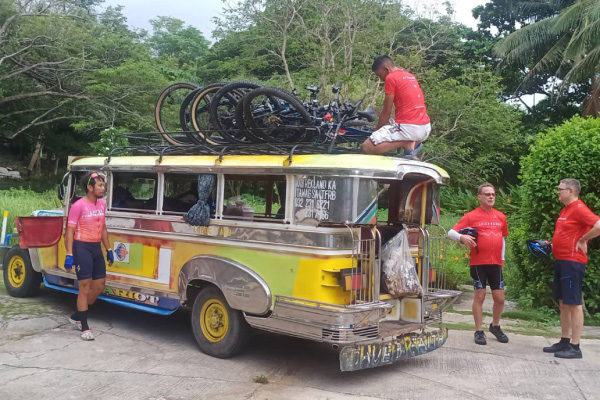
5.The Jeepney: The Most Fun You'll Have in a Support Vehicle
What is it?
After World War II, American military jeeps were left behind across the Philippines. Filipinos did what Filipinos do — they made them their own. Jeepneys are extended, open-air, bench-lined vehicles decorated with chrome, mirrors, saints, horses, and hand-painted artwork. No two look the same. They are loud, colourful, and completely iconic.What actually happens?
On both of our Philippines tours, jeepneys serve as the official support vehicles in Bohol and Siquijor — following the group along the route, carrying bags and supplies, and offering a seat to anyone who needs a rest from the pedalling. There's no air conditioning. There's no glass between you and the passing countryside. There's just open air, the sound of the road, and a vehicle that feels like it was designed by someone who wanted travel to be joyful.Why it's special:
It's a small thing in the context of a 12 or 13-day tour. But it's also a reminder of what makes cycling travel different from any other kind. You're not watching the Philippines from behind a window. You're in it — bumping along the same roads, in the same vehicles, as the people who live there.That's the SpiceRoads way. And in the Philippines, it doesn't get more local than a jeepney.
So, Which Tour Is Right for You?
If you're an experienced road cyclist looking to push yourself across four islands and 762 km — including the sugarcane plains of Negros — Road Cycling the Philippines is your ride.If you're looking for something more relaxed, with shorter days, more time to explore, and a pace that lets you actually absorb everything around you, Island Hopping the Philippines across Cebu, Bohol, and Siquijor is the one.
Either way, the Philippines will give you far more than great roads and scenery. It'll give you stories you won’t stop telling mates about when you get back
Find out more at www.spiceroads.com/tours/philippines


